NURBS_BEM_EMSolver
A mesh-free NURBS-based boundary element solver for solenoid magnetic-field computation, written from the integral formulation through to code. It generates the multifidelity electromagnetic datasets the surrogate work below is trained on, and carries a closed-form verification suite that runs in CI.
Read the full case study →
Surrogate-model-learning
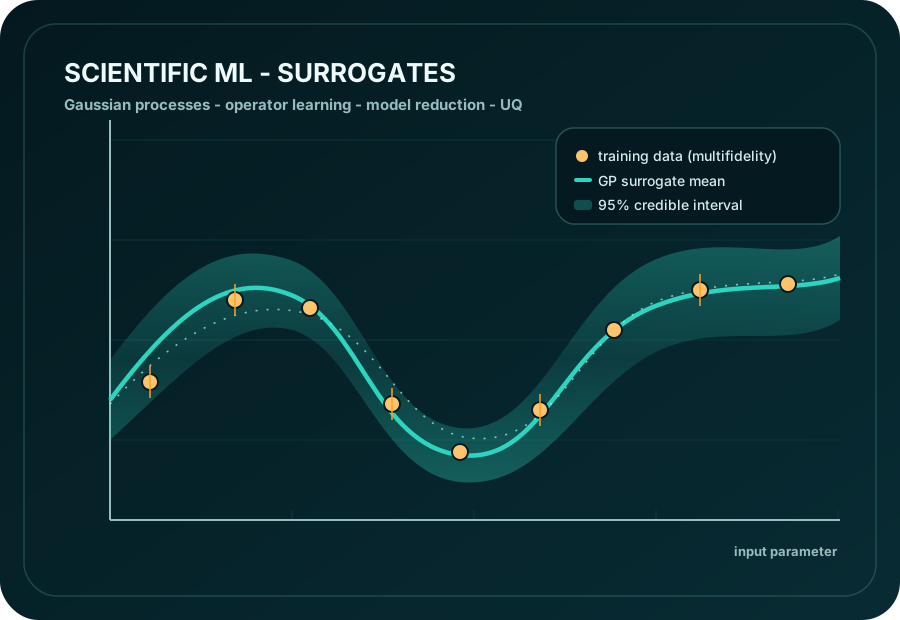
A systematic study of surrogate methods from first principles, including Gaussian process regression, response surface methods, radial basis functions, uncertainty behavior, and failure modes of approximation.
What I am working toward
A clearer account of why surrogate models generalise, how their uncertainty can be quantified, and where their assumptions break down — stated precisely enough to be tested rather than asserted.
Why it matters
A surrogate is only useful if you know where it stops being accurate. These projects are about characterising that boundary rather than reporting a single error metric — which is the same question as the rest of my work, asked about approximations instead of pipelines.