Applied regression study
Added OLS, log-OLS and ridge comparisons, interaction terms, HC3 coefficient intervals, VIF and residual/influence diagnostics. On a grouped split of 768 UCI Ecotect simulations, held-out R² was 0.880 for heating and 0.820 for cooling. This is an independent retrospective study of simulation data. Concrete screening now requests measurements for uncertain or out-of-domain predictions.
Question
Can a surrogate remain useful when the held-out data represents genuinely different operating conditions or designs? The work compares Gaussian-process, polynomial, RBF, and tree-based regressors on UCI airfoil self-noise, energy-efficiency, and concrete-strength data.
Evaluation design
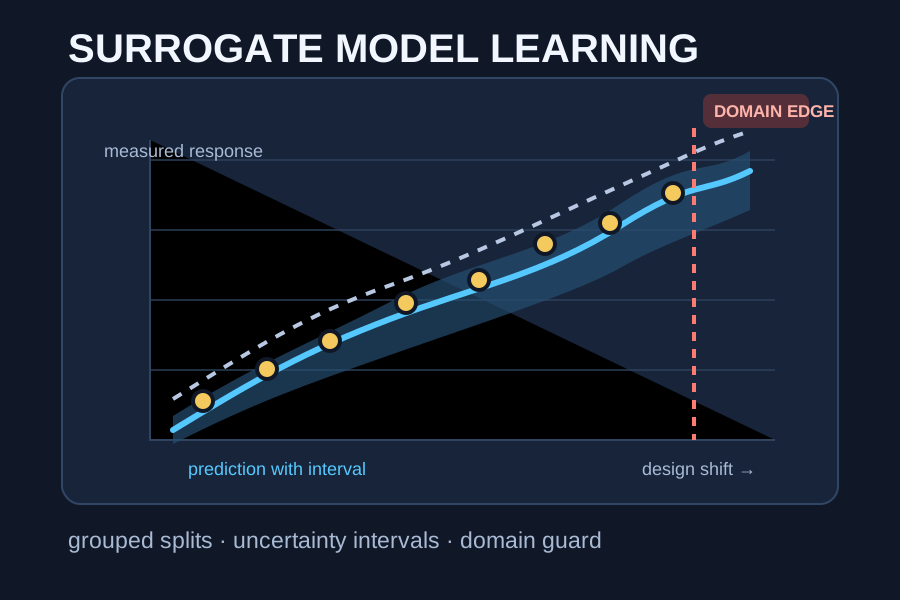
Rather than relying only on random train/test splits, the experiments use grouped physical-design splits, multi-seed robustness checks, split-conformal intervals, and distance-to-training-domain guards. This makes split sensitivity and uncertainty calibration visible.
What the evidence says
On an airfoil grouped split, the Gaussian process obtained R² 0.8145. Across ten seeds, mean R² was 0.8662 ± 0.0680, showing that the choice of withheld physical conditions materially affects the result. Nominal 90% uncertainty intervals did not retain 90% coverage after design shift.
Engineering takeaway
The project does not treat nominal uncertainty as proof of reliability. It tests whether uncertainty is calibrated where it matters and documents where the guard has limits. This is the discipline needed before a learned surrogate is trusted in a design workflow.